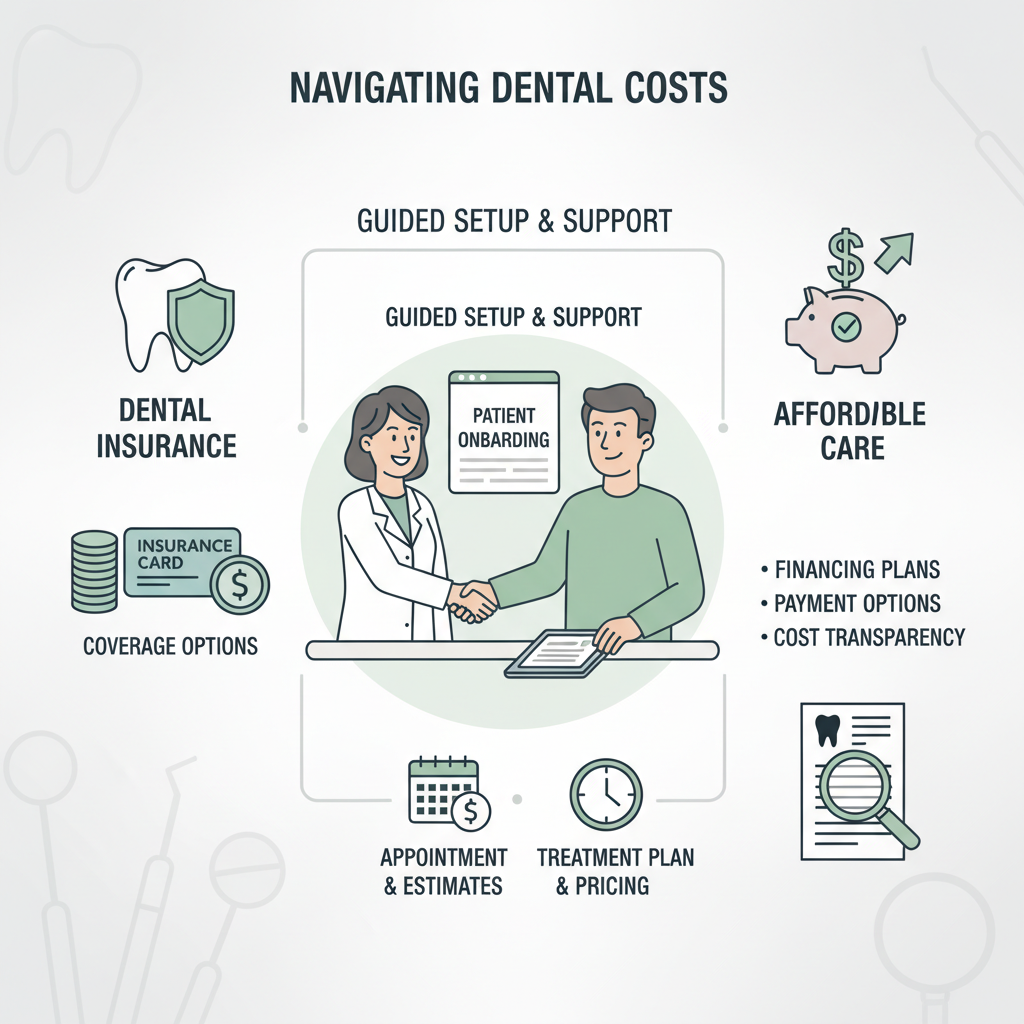

Why dental financing options matter
Dental care is essential to your overall health, yet the cost of treatment can feel overwhelming. Even if you have insurance, you might still face deductibles, annual maximums, or procedures that are not covered at all. This is where dental financing options can make a real difference for you.
By spreading costs over time, you can move forward with the care you need instead of delaying treatment because of a single large bill. Understanding how financing works, what types of options are available, and how to use your insurance wisely helps you lower your out-of-pocket costs and plan ahead with confidence.
Understanding your dental costs upfront
Before you think about financing, you need a clear picture of what your treatment will cost and how much your insurance will pay.
At your initial visit or dental consultation in Charlotte NC, you can request a detailed breakdown of recommended treatment, including:
- The total cost of each procedure
- What your insurance is expected to cover
- Your estimated portion out of pocket
If you are comparing providers, a written dental cost estimate in Charlotte helps you see the full picture. A practice that values transparent dental pricing will explain line by line what you are paying for and why a particular treatment plan is being recommended.
This level of clarity gives you the information you need to decide whether to pay in full, use financing, or adjust the timing of your treatment.
Make the most of your dental insurance
If you have dental insurance, your first step in reducing out-of-pocket costs is to use your benefits strategically. A truly insurance friendly dental practice will help you navigate this process instead of leaving you to figure it out on your own.
Confirming coverage and in‑network savings
You can often save significantly by choosing an in-network dentist in Charlotte. In-network contracts typically reduce the overall fees for your procedures, which means your coinsurance and any uncovered balance are calculated on lower amounts.
Before treatment begins, ask the office to perform insurance verification. This step confirms:
- Whether the dentist is in network with your plan
- Your remaining annual maximum
- Any waiting periods or exclusions that could affect coverage
Some practices also provide an overview of the insurance accepted for dentistry on their website so you know in advance if your plan is a good fit.
Using benefits before they reset
Most dental plans renew every calendar year. If you delay needed treatment until next year, you may lose remaining benefits that could reduce your out-of-pocket costs right now. Many offices encourage you to use your benefits before they reset so you are not paying unnecessarily for care that could have been partly covered.
If your treatment is extensive, the team can sometimes phase your treatment plan consultation to fit within two benefit years. For example, you may complete part of the work this year up to your maximum, then schedule the remaining treatment early next year when your benefits renew. This type of planning can significantly lower what you pay out of pocket over time.
Common types of dental financing options
Once you understand your estimated costs and insurance coverage, you can look at how to cover your portion. Dental financing options fall into a few main categories, each with its own advantages.
In‑office payment plans and memberships
Many practices offer their own flexible arrangements that are designed specifically for patients who want affordable dental care in Charlotte.
You may see options such as:
- Zero interest short-term payment plans for smaller balances
- Extended dental payment plans in Charlotte for larger treatments
- In-house membership plans that bundle preventive care with discounts on additional services
Membership programs, similar to those offered by practices like CarolinasDentist, can include essential preventive visits and reduced fees on restorative or cosmetic work, which makes ongoing care more manageable if you do not have traditional insurance [1].
These office-based arrangements are often straightforward, with clear terms and no surprise fees. If you value simplicity and want to keep everything under one roof, it is worth asking about these options during your first dental visit in Charlotte.
Third‑party healthcare credit cards
Healthcare credit cards are another popular form of dental financing. Providers such as CareCredit partner with dental offices so you can apply during your visit and pay your balance over time.
CareCredit, for example, is widely accepted across the United States and can be used for general, preventive, restorative, and cosmetic dentistry at more than 285,000 provider locations [2]. These cards typically offer special promotional financing, such as:
- Short-term plans with no interest if you pay the full balance by a set date, subject to credit approval
- Longer-term plans with fixed monthly payments and interest over a defined period
For many patients, this type of card is a convenient way to handle expenses like crowns, dentures, or clear aligners, especially when the total cost exceeds what they can pay in a single visit. Users often report that financing significant treatments through CareCredit made it possible to address urgent or complex needs without delay [2].
When you consider any healthcare credit card, review the terms carefully. Make sure you understand the promotional period, what happens if a balance remains after that period, and whether there are any fees associated with the account.
Installment plans through third‑party providers
Some practices partner with companies that specialize in fixed monthly payment plans for healthcare. Cherry Payment Plans, for example, offer financing for dental costs up to 50,000 dollars with terms as short as six weeks, which are always interest free, and as long as 60 months with qualifying 0 percent APR or competitive fixed rates [3].
Key features of Cherry-style financing include:
- A quick application process that typically takes under 60 seconds
- Soft credit checks for initial approval, which protects your credit score in most cases
- Instant or same-day decisions with an approval rate that can reach up to 90 percent [3]
Dental offices benefit because they receive full payment quickly, usually within two to three business days, while you repay over time directly to the financing company. Merchant fees are designed to be lower than many competing services, and there are no origination or prepayment penalties charged to you [3].
These plans can be especially helpful if you want predictable monthly payments and do not want a revolving credit card account.
Personal loans for dental procedures
If you prefer not to use a card or in-office plan, you can consider a personal loan specifically for dental care. Dental loans are unsecured personal loans that you use to pay for treatments such as implants, braces, or oral surgery. Interest rates generally range from about 7 percent to 36 percent, and loan terms are often between two and seven years [4].
Lenders highlighted by financial reviewers include:
- LendingClub, often rated among the best overall choices, with loans from 1,000 to 60,000 dollars, minimum credit scores around 600, and funding that can arrive within 24 hours. You should be aware that an origination fee of up to 8 percent may apply [4].
- Upgrade, which is known for working with borrowers who have fair or borderline credit, around 600 or higher. It may allow co-signers or collateral to help you qualify or secure better terms, and it also charges an origination fee that is deducted from your loan proceeds [4].
- Upstart, which considers your education, income, and employment history in addition to your credit score and can approve applicants with scores as low as about 300. Loan amounts range from 1,000 to 75,000 dollars with APRs roughly between 6.20 and 35.99 percent, and funding can often arrive as early as the next business day [5].
Other lenders like LightStream, SoFi, PenFed Credit Union, and Prosper may offer favorable rates for borrowers with strong credit, larger loan amounts, or specific term preferences [5].
If your credit is challenged, financial experts generally recommend avoiding dental loans with APRs above 36 percent, since you could end up paying nearly as much in interest as you borrow. Using a co-signer, joint application, or secured loan can sometimes help you qualify for a lower rate [4].
Alternative ways to reduce what you pay
Financing is only one part of making care affordable. You can also combine other strategies to lower how much you pay over time.
Using HSAs, FSAs, and tax‑advantaged funds
If you have a Health Savings Account (HSA) or Flexible Spending Account (FSA), you can use those funds for qualified dental expenses. This can give you a tax advantage that effectively reduces the cost of treatment. Some practices accept HSA card payments at the time of service or coordinate with your benefits so you can submit receipts for reimbursement [1].
Taking advantage of new patient promotions
If you are searching for a dentist accepting new patients in NC, look for a dental office new patient special. These offers often bundle exams, X-rays, and cleanings at a reduced fee for your first dental visit in Charlotte.
New patient promotions can lower your initial costs and help you establish care at a practice that fits your needs. Once you are established, you can work together with the team to plan any additional treatment over time in a way that fits your budget.
Considering discount and membership plans
If you do not have insurance, a practice that focuses on affordable dental care in Charlotte may offer in-house savings or membership plans. These programs typically include:
- Preventive services like cleanings, exams, and X-rays
- Percentage discounts on restorative and cosmetic care
- No waiting periods or annual maximums
This structure can be especially helpful when you want predictable costs and do not want to navigate traditional insurance limitations.
How financing supports timely treatment
One of the biggest benefits of having clear dental financing options is that you do not have to postpone necessary care due to cost concerns alone. Delaying treatment often leads to more complex and expensive problems later. A small cavity that is manageable today can become a root canal or extraction if it is left untreated.
Patient financing can increase case acceptance and reduce the time you spend deciding whether to move forward with recommended care. The American Dental Association notes that offering financing tends to help patients manage costs that exceed their expectations or coverage, and it can support better oral health outcomes overall [6].
When your dentist explains both the clinical reasons for treatment and the financial pathways available, you can focus on your health rather than on avoiding a difficult conversation about cost.
When you understand your options clearly, cost becomes a manageable planning issue instead of a barrier that keeps you from getting the care you need.
What to ask before choosing a financing option
Before you commit to any financing plan, it is wise to ask a few specific questions so you know exactly what to expect.
Consider asking:
- What is my total treatment cost, and what portion is due from me after insurance?
- Which financing options does your office offer directly?
- Are there third-party financing partners, and what are the basic terms?
- Is there a credit check, and if so, is it a soft or hard inquiry?
- Are there any fees, such as origination charges or late fees?
- Is there a penalty if I pay off the balance early?
You can also ask your dental team to compare a few options side by side. For example, they might show how your monthly payment would look with a short-term in-house plan versus a longer-term third-party plan, so you can align your choice with your cash flow and financial goals.
What to expect as a new patient
If you are new to a practice, look for one that combines quality clinical care with practical support around cost and coverage.
A practice that welcomes new patient dental visits in Charlotte typically helps you with:
- Scheduling a convenient dental consultation in Charlotte NC
- Verifying your insurance benefits before your appointment
- Explaining which in-network dental services are covered
- Outlining all available [dental financing options] and payment plans
Many patients appreciate offices that make it easy to schedule a dental appointment in Charlotte online or by phone, especially when you are balancing work, family, and other responsibilities.
If you do not have insurance or are unsure about your coverage, you can also look for an insurance friendly dental practice or dentist accepting insurance in Charlotte that is experienced in working with a wide range of plans.
Taking your next step with confidence
Your oral health affects your comfort, your confidence, and your overall well-being. Cost should be part of the conversation, but it does not have to be the obstacle that keeps you from moving forward.
By:
- Understanding the true cost of dental services through clear estimates
- Maximizing your insurance benefits with an in-network dentist in Charlotte
- Exploring in-office plans, healthcare credit cards, third-party payment plans, and personal loans
- Asking direct questions about terms, interest, and fees
you put yourself in a stronger position to choose the dental financing options that fit your life.
If you are ready to explore your choices, you can start by connecting with a dentist accepting insurance in Charlotte or by using convenient tools to schedule a dental appointment in Charlotte. With the right support, you can prioritize your oral health, manage your budget, and move forward with a treatment plan that feels both clinically sound and financially realistic.
References
- (CarolinasDentist)
- (CareCredit)
- (withcherry.com)
- (NerdWallet)
- (CNBC Select)
- (ADA)